Bicolor Butterfly Bush Growth Habit: Arching or Upright?
Picture a late-summer evening on the patio. The border in front of you has gone soft and heavy, and butterflies are drifting from one flower to the next. Somewhere in that picture a mid-height shrub gives the whole planting its outline, and you usually notice its shape only when it is missing.
If you search for a full grown Bicolor Butterfly Bush, you mostly find height and width numbers. You rarely find out what the plant looks like: whether the stems stand up like a vase or lean out like a fountain, and whether the flowers weigh them down.
This article talks about the mature shape of Bicolor Butterfly Bush and answers the questions customers ask us most. Read on to learn where it sits in a landscape, how its branches behave, whether the clusters need staking, and what one bloom cluster looks like up close.
Picture the Whole Garden in Late Summer
Start with the border, not the plant. A shrub's shape only makes sense against what surrounds it, so we begin with the whole scene.
Think of a mixed bed in late August. Coneflowers and asters hold the front, ornamental grasses stand tall with their seedheads, and a fence or a small tree closes the back. Between the low layer and the tall layer there is usually a gap at about waist to shoulder height. That is the slot a butterfly bush fills.
In that slot, Bicolor does something its neighbors cannot. Perennials stand exactly where you planted them, and grasses sway but stay tight. A butterfly bush leans out over them and hangs its flower spikes into open air, at the height where you stand and where the visitors fly. That is why a border with one looks alive from the patio. Our guide to butterflies, bees and birds on Bicolor covers who shows up.
The scent belongs to the picture too. The flowers are fragrant, and on a warm evening that sweetness drifts across the patio before you ever walk up to the bed. A shrub that holds its blooms at nose height delivers it far better than one that keeps them overhead.
Timing matters as well. The species blooms from June to September, so this middle layer is still carrying the border when many perennials have gone to seed. Our Bicolor bloom guide has the color and timing details. The shape we are about to describe is what you see while all of that happens.
Where Bicolor Butterfly Bush Sits in the Landscape
Size numbers tell you how much room to clear. Silhouette tells you what job the plant can do. Our size guide has Bicolor's numbers, so here we place it by shape.
One thing to keep in mind from those numbers: the species spreads 4 to 15 feet wide, which is a broad range. Compact davidii cultivars such as 'Attraction', at 4 to 6 feet tall and wide, sit at the small end. A plant with that much potential spread wants its sides respected, whatever its final size.
As a Backdrop
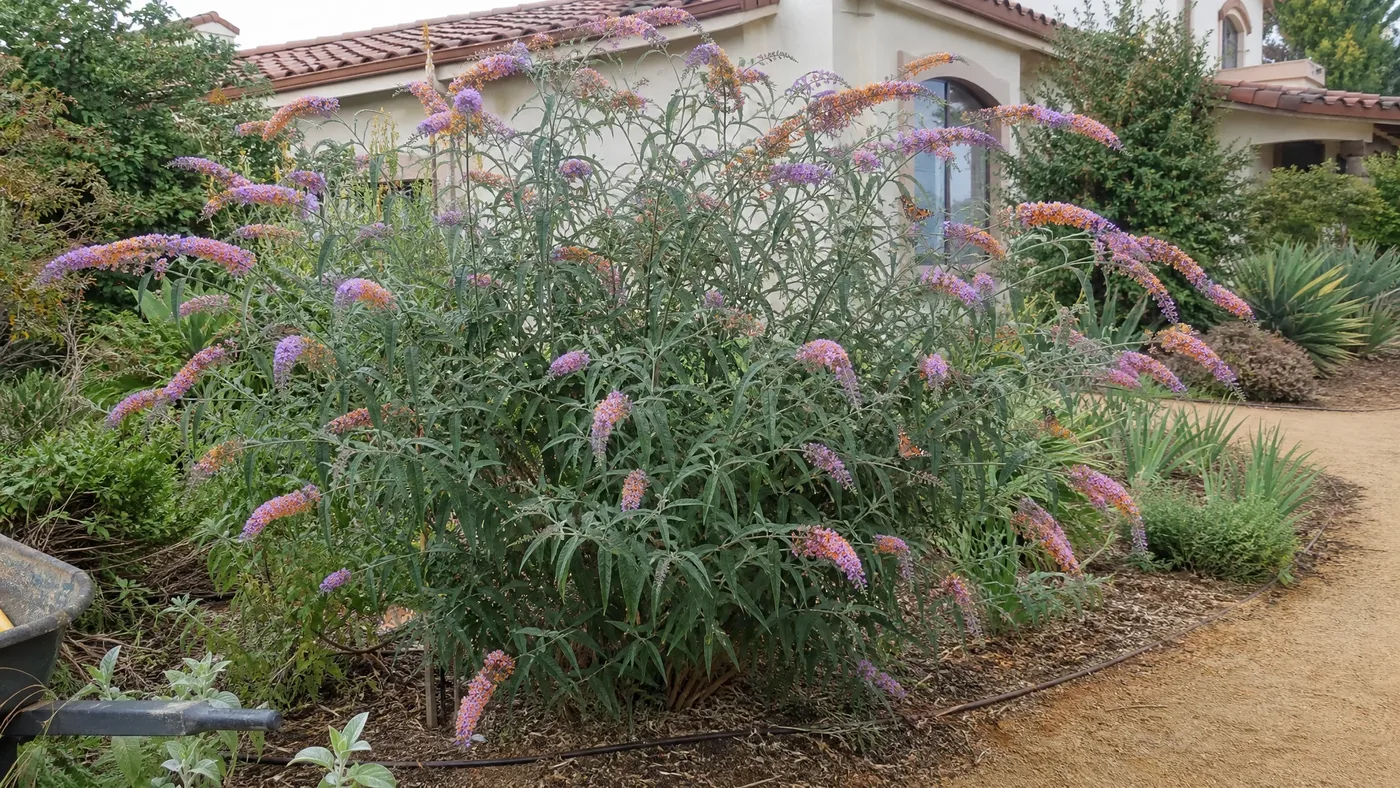
At the back of a bed, the arching habit does quiet work you would not get from a stiff shrub.
The outer stems fall forward over the plants in front and soften the hard line of a fence or wall. Leave a gap at the back so the arch has room to drop, and keep low plants in front that tolerate a little shade from overhanging stems.
Seen from across a lawn, a backdrop planting reads as one rounded, rolling mass rather than a row of separate uprights. That is the effect most customers are picturing when they ask us for "a full, natural hedge" of flowers.
In a Corner
Corners are where this shape earns its place over an upright one.
A vase-shaped shrub stands in the angle and leaves empty wedges on either side. Bicolor's stems reach outward and then down, so they fill the corner from the base to the flowering tips. Set the crown a little way in from both walls and let the stems do the filling.
Along a Path Edge
A path is the most demanding spot, because you will meet the plant at arm's length.
Plan for the reach of the stems in full bloom, not the width of the crown at planting. Put it far enough back that the heaviest stems clear the walking line, and the clusters will brush your sleeve at nose height. Early spring pruning, covered in our pruning guide, is how you set the edge each year.
Avoid planting it where a stem could hang across a narrow doorway or a gate swing. Arching growth is lovely until it is in your way, and moving a mature shrub is far harder than choosing the right spot on day one.
An Arching Fountain, Not a Stiff Vase
Here is the answer to the title question. Bicolor arches, and we would choose it for exactly that reason.
Butterfly bush in general leans that way. The species is a shrub with a bushy habit and arching stems. Bicolor goes a step further. Its weyeriana parentage makes the stems more pliable than those of the stiffly upright davidii cultivars.
That parentage is a cross of B. davidii and B. globosa, and the hybrid has an arching and spreading habit. The davidii side comes from Tibet and central and south China. The result is a plant that fountains outward and tips over at the ends, where a pure upright type holds its stems stiffly.
Who Should Choose the Fountain
If your bed is wide, mixed and meant to feel soft, Bicolor is the better pick. It rewards loose, cottage-style plantings, where the stems can lean into their neighbors and the whole border moves in a breeze.
If you need a narrow column beside a doorway, or a clipped, upright formality, a stiffer davidii cultivar fits better, and we would say so. Common advice is to prune any butterfly bush into a tidy upright vase. We would rather you let this one fountain.
What the Weyeriana Side Costs
There is one caution on the weyeriana side, and it concerns winter rather than shape.
The hybrid is less winter hardy than other Buddlejas and may die back to the roots in zones 5b or 6. Because the flowers come on new growth, a plant that regrows from the base still gives you fresh arching stems. Our winter care guide for cold climates covers protecting the crown where it matters.
Reading the Branches of Bicolor Butterfly Bush
Once you know the overall silhouette, the branches tell you how healthy and well sited the plant is. Here is what to look at.
Stem Character
Bicolor is multi-stemmed, with many shoots rising from the crown rather than one trunk. The 'Attraction' cultivar has a form that is arching, dense, erect, mounding and multi-stemmed, so even the compact davidii cultivars are not rigid. Bicolor leans further toward the arch.
The stems are pliable. Bend a young one gently and it gives, rather than snapping. That springiness is what lets the plant carry a heavy flower load without damage.
How the Arch Develops
New stems rise first and lean as they lengthen and the buds swell. The arch is mostly a late-season shape, which is why a plant that looks upright in June can look like a fountain by August.
Oregon State notes that the flowers are borne on new growth, so every stem builds its own weight in a single season. A bend at the tip is normal. A stem that flops from the base is a warning sign.
In our rows, that flopping usually means too little sun. The plant wants six or more hours of direct light, and shaded plants stretch and lean instead of arching cleanly. Our sun requirements guide explains how to judge a site.
Healthy Bend Versus Trouble
The easiest way to tell the difference is to look at where the curve begins.
A healthy arch starts partway up the stem and sweeps gradually outward, with firm, evenly leafed wood all the way to the tip. A stem that leans hard from the crown, looks thin and pale, or has wide gaps between leaves is reaching for light or short on room. Fix the site rather than the stem.
Do Bicolor Butterfly Bush Clusters Need Staking?
One of the most common questions we get is whether the heavy clusters need support. For an established plant in full sun, our answer is usually no.
The bowing is part of the plant's design. Stiff upright butterfly bushes are the ones that benefit from stakes, because they resist the load until they crack or lean awkwardly. Bicolor's pliable stems bend and spring back. Tying them upright fights the form you chose it for.
When a Stake Does Help
Support does help in a few situations. This table sorts them by what you see and what we would do.
| Situation | What we would do |
|---|---|
| Established plant, full sun | No stake. Let the stems bow. |
| First-season plant after planting | Wait. The stems are still thickening, so give them time before judging. |
| Shaded, stretched, floppy from the base | Move toward more sun. A stake only hides the problem. |
| Exposed, windy spot | A discreet support for the heaviest stems is reasonable. |
| Stems blocking a path | Prune the edge in early spring rather than tying back. |
Supporting Without Spoiling the Arch
If you do decide to help a stem, the aim is to hold the weight, not to straighten the line.
Use a soft tie, set low on the stem, and keep the support out of sight behind neighboring perennials. Leave the tip free so it can still droop and sway. A stem lashed bolt upright in a bed of stiff-stemmed neighbors loses everything that made the shrub worth planting.
We grow and send young plants, so the arch comes as the stems lengthen over the first seasons. Judge the habit in its second summer, not on the day it arrives.
Up Close on One Whorled Cluster
Now zoom in to the detail that explains the whole shape: a single flower cluster and how it sits on the stem.
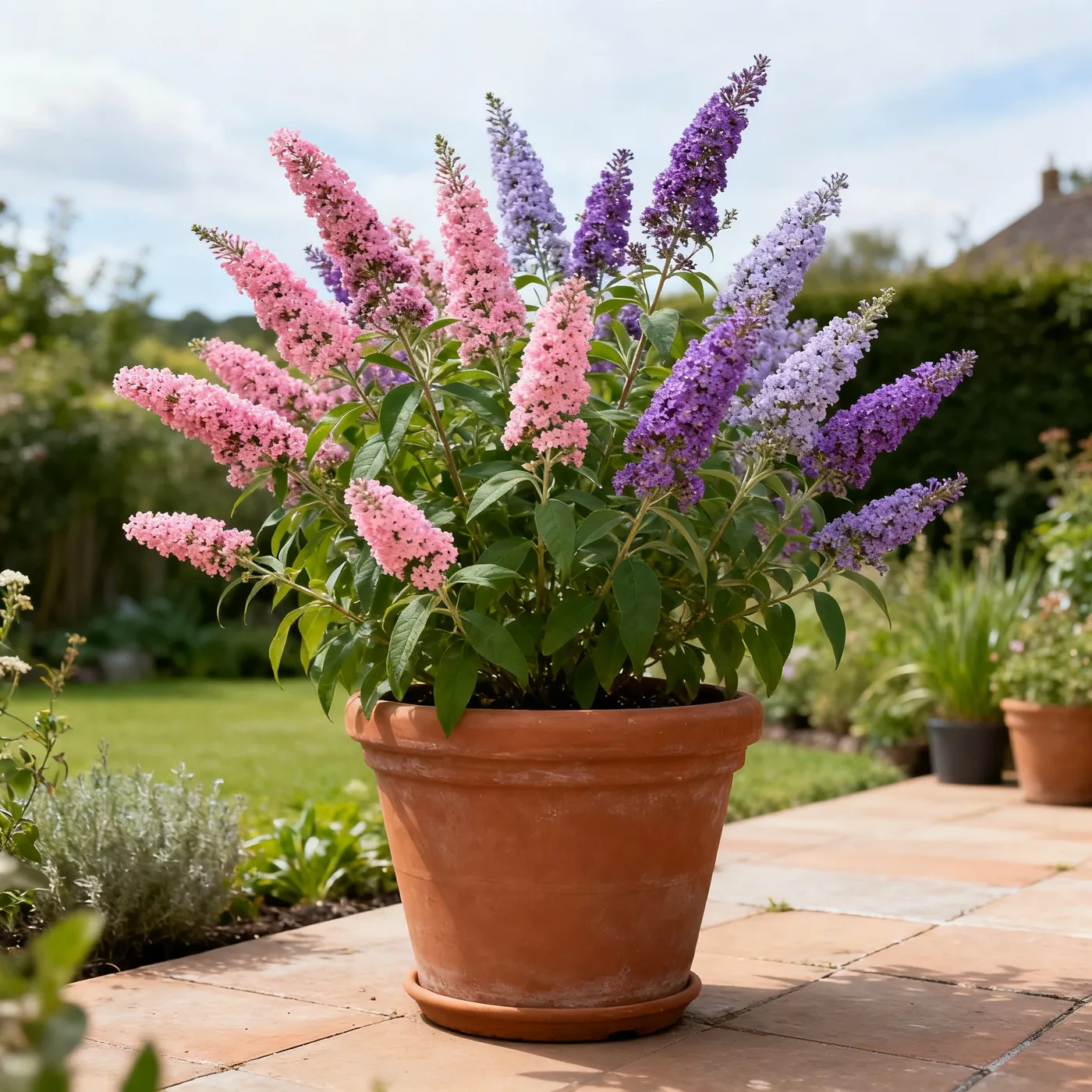
The species' flower panicle is 4 to 10 inches long. Dense, fragrant sprays can reach 30 centimeters or more, which is about 12 inches or longer. Each spray is built from many small flowers set in rings, or whorls, around the central spike, packed tightly enough that the spike reads as one solid plume.
How the Spike Sits on the Stem
Where the spike sits matters for the whole bush.
It forms at the end of a stem that grew this year, so all that weight hangs at the tip. A lever loaded at its far end bends, and that is exactly the curve you see. Over the weeks, the rings open and the plume lengthens, so the bow deepens as the bloom matures.
What You See and Smell at Arm's Length
Lean in and the cluster rewards a slow look.
The species' flowers are lilac with an orange throat, so each tiny floret has a bright eye at its center. The rings open from the base of the spike upward, so a single plume often carries open flowers below and tight buds at the tip. Butterflies work those rings one by one.
Stand beside one in late summer and you can see the whole logic in a single stem: pliable wood, a heavy fragrant tip, and a visitor settling on it.
Why Bicolor Butterfly Bush Shapes the Whole View
Pull back from the single cluster and you are looking at the border again. Our landscape design ideas show the shrub in specific combinations, and the lesson is the same in each: plan its place by silhouette. Fill corners, soften backdrops, and give path edges room for the reach of the stems. Because flowers come on new growth, Oregon State's early spring pruning lets the plant rebuild its arch every year, and in full sun an established plant rarely needs a stake.
Bicolor Butterfly Bush
Nursery-grown Bicolor Butterfly Bush in sizes from Quart, shipped to your door.
From $25.33
Shop Now →Come back to the patio once the blooms open and you will see the arching stems swaying under the weight of their flowers, with the butterflies riding every sway. Customers keep coming back to us for Bicolor because the top-quality plants we grow on our own farms give their borders that fountain of stems, year after year.